


When it comes to core and pelvic floor recovery we’re often told to start with the basics and rebuild a foundation, first. But what does this actually look like?
After pregnancy and birth, many people are eager to regain their core strength but often, the focus goes straight to ab exercises or isolated pelvic floor work, like doing endless Kegels. While strength is important, what’s often missing in early postpartum recovery is coordination. The ability for the core, pelvic floor, breath, and surrounding muscles to work together as an integrated system.
During pregnancy, your body undergoes major structural and physiological changes that affect how your core and pelvic floor function. For example:
• The abdominal wall stretches to accommodate the growing uterus, often leaving the core muscles including the transverse abdominis and obliques lengthened and temporarily less able to generate tension.
• The diaphragm shifts upward as the uterus expands, altering breathing mechanics and reducing the natural pressure system that normally supports core stability.
• The pelvic floor carries increased load for months as it adapts to support the weight of the baby, fluid and uterus.
• Posture often changes, with common patterns like anterior pelvic tilt, rib flare, and hip compensation, all of which can affect how muscles coordinate during movement.
• Birth itself creates additional demands on the system. With a vaginal delivery, the pelvic floor may be recovering from tearing, overstretching or temporary nerve irritation. With a C-section, the abdominal wall and surrounding tissues may be healing from surgery, which can influence muscle activation, sensation, and coordination.
Because of these changes, it’s not just about rebuilding strength, it’s about retraining coordination. The breath, pelvic floor, core, glutes and even the upper body all need to re-learn how to stabilize, generate pressure and respond reflexively to movement.
Simply strengthening your abs or squeezing your pelvic floor in isolation doesn’t address the root issue: the system has to work together.
That’s why I focus on strategies that improve not only muscle activation, but how your body coordinates itself under load through breathing, positioning and muscle synergy. When you rebuild coordination, strength follows and you’ll be more prepared for heavier lifting, running, or high impact activities without symptoms or dysfunction.
The rest of this post breaks down some key foundational strategies that help re-establish that coordination through movement patterns and muscle groups that are often overlooked in traditional core training.
1. Hamstrings: Restoring Pelvic Control
The hamstrings are one of the most overlooked muscles in postpartum recovery, yet they play a critical role in how the pelvis and core function together.
These muscles run from the back of the pelvis (the ischial tuberosity) down to the lower leg, crossing both the hip and knee joints. Because of this attachment, the hamstrings have a strong influence on pelvic positioning and control.
During pregnancy, it’s very common for the pelvis to shift into a more anteriorly tilted position as the growing belly pulls the center of mass forward. This shift often leads to increased reliance on the lower back and hip flexors while the hamstrings become relatively underused.
When the hamstrings engage well, they help:
• Bring the pelvis back toward a more balanced position
• Support the glutes during hip extension
• Reduce unnecessary strain on the lower back
• Improve coordination between the hips and the deep core
Hamstring training also helps reconnect the posterior chain, which includes the glutes, hamstrings and spinal stabilisers. This system works together to support everyday movements like hinging, lifting, walking, and carrying your baby. Instead of thinking about hamstrings purely as a “leg muscle,” it’s helpful to think of them as a key player in pelvic control and core coordination.
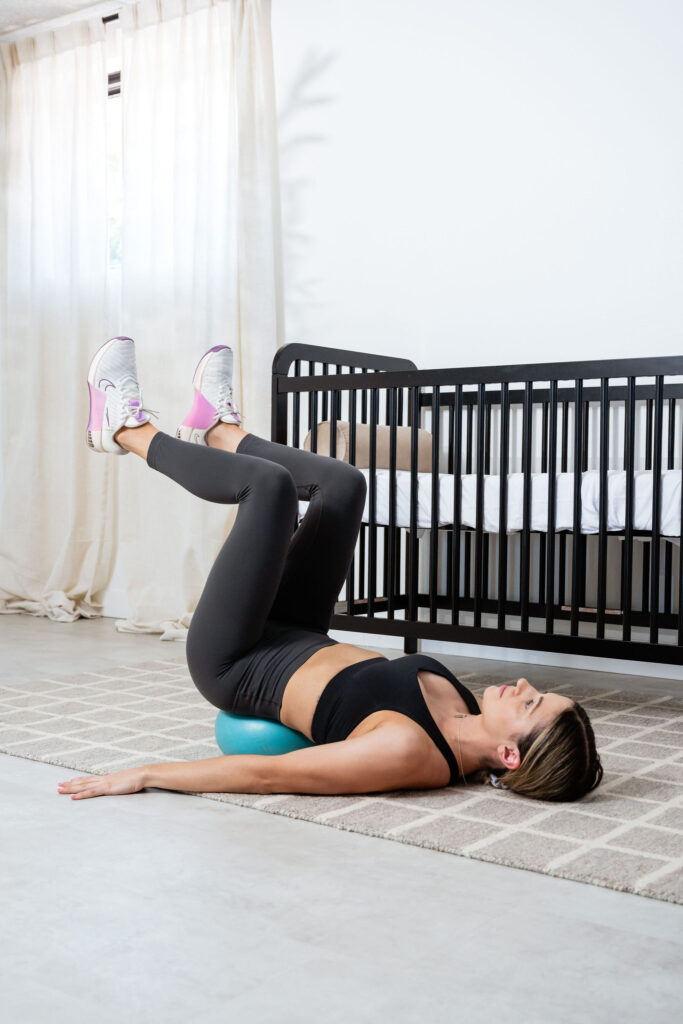
An effective postpartum-friendly hamstring exercise, and often a starting point in my programs is the 90/90 hip lift.
When you activate your hamstrings in a 90/90 position (hips and knees at 90 degrees, feet on the wall or elevated), they help draw the pelvis under, pulling it into a more neutral or slightly posterior tilt. This repositioning:
- Creates a more optimal environment for the lower abs to engage
- Reduces the dominance of the hip flexors
- Promotes a more stacked alignment of the ribcage over the pelvis
- Allows for better exhalation, which activates the deep core and pelvic floor
This isn’t just about feeling your hamstrings. It’s about using them as a tool to create the right setup for core and pelvic floor coordination to happen naturally.
In fact, many clients I work with are shocked at how much more core engagement they feel simply by learning to use their hamstrings effectively in supported positions.
2. Adductors: Supporting the Pelvis and Pelvic Floor
The adductors, or inner thigh muscles, are another key piece of the postpartum recovery puzzle.
They also have an important anatomical relationship with the pelvic floor through shared fascial connections. Together, they help manage pelvic position, pressure and stability, particularly during asymmetrical or high load movement. Because of this relationship, force generated or absorbed by the adductors directly influences how the pelvic floor responds and vice versa. When adductor strength and timing are reduced, the pelvic floor is often asked to compensate by increasing tone or bracing to maintain stability.
As both systems adapt to longer positions and reduced dynamic demand during pregnancy, this relationship can become less efficient. The pelvic floor may struggle to respond quickly to changes in load, while the adductors lose their role in sharing force across the pelvis. Restoring adductor capacity therefore isn’t just about inner thigh strength; it plays a key role in improving pelvic floor responsiveness, reducing unnecessary tension and supporting coordinated movement across the hips and trunk.
This often shows up as hips that feel restricted or unstable in lateral movement, and adductors that present as “tight” despite lacking true strength or control. Tension becomes a compensatory strategy, particularly when the system is asked to manage single leg tasks, running or changes of direction. During pregnancy, this same pattern can also contribute to pelvic girdle or symphysis related pain when the pelvis lacks shared muscular support.
Restoring function here isn’t about isolating one muscle or forcing flexibility. It’s about rebuilding coordination between the adductors, pelvic floor, glutes and deep hip rotators — allowing them to share load again, respond to pressure changes and support movement across all planes.
Supine Band Adduction
Lying on the back provides a stable position to isolate adductor engagement while maintaining pelvic alignment. Pulling the leg inward against the band challenges the inner thigh muscles while the pelvis remains steady. This exercise helps reinforce adductor activation without compensations from the hips or lower back.
3. Obliques: Rebuilding Rib–Pelvis Coordination
When people think about core strength, they often focus on the front of the abdomen.
But the obliques, which run along the sides of the torso, are some of the most important muscles for restoring coordination between the rib cage and pelvis.
During pregnancy, the rib cage expands and the abdominal wall stretches to accommodate the growing uterus. This can change how the obliques function and often leads to patterns like rib flare or upper abdominal gripping. The obliques help bring the rib cage and pelvis back into a more balanced relationship. When functioning well, they help:
• Control trunk rotation
• Stabilise the spine during movement
• Support intra-abdominal pressure regulation
• Reduce excessive strain through the abdominal wall
This makes them especially important for postpartum recovery, where restoring pressure control and trunk stability is key.
Kneeling Pallof Press with Isometric Adductors
The kneeling position limits lower body movement so the trunk must stabilise against the band’s rotational pull. Maintaining an adductor squeeze throughout the movement adds an additional layer of pelvic stability while the pallof press challenges the core to resist rotation. This combination reinforces coordination between the inner thighs and trunk stabilisers.
4. Serratus Anterior: Restoring Rib Cage Control
The serratus anterior is often an overlooked muscle in postpartum rehab, but it plays a powerful role in core function and full-body strength. Here’s how and why: It’s a fan-shaped muscle that wraps around the rib cage, attaching from the upper ribs to the scapula (shoulder blade). It helps protract (move forward) and stabilize the shoulder blade, especially during reaching, pushing, and overhead movements. While it’s often discussed in relation to shoulder health, it also plays an important role in breathing mechanics and core coordination.
Why it matters postpartum:
- Reintegrates the core-shoulder connection: During pregnancy, core pressure increases and movement compensations often develop, leading to disconnection between the core and upper body. Strengthening the serratus helps rebuild that chain by teaching your body to stabilize from the rib cage up, not just from the abs down.
- Improves rib position & diaphragmatic breathing: The serratus helps anchor the ribs and improve rib cage mechanics, which supports better diaphragmatic breathing. That’s huge for core rehab, since breath plays a key role in pressure management, pelvic floor function, and deep core activation (like TVA and pelvic floor synergy).
- Supports scapular stability & posture: Many postpartum women experience rounded shoulders and/or poor posture from nursing, carrying babies, and core weakness. Serratus strength helps reposition the scapula, improving shoulder mechanics and reducing neck/upper back tension.
- Enhances core engagement during arm movement: You need a strong, stable core to support arm and shoulder motion – especially for lifting, pushing strollers, or carrying car seats. Training the serratus ensures that shoulder movement doesn’t compromise core integrity, which is vital during postpartum recovery.
Quadruped Banded Serratus Push-Up
In the quadruped position, the hands press into the floor while the upper back gently rounds against the resistance of the band. This movement encourages the shoulder blades to glide around the rib cage rather than collapsing toward the spine. It’s a simple but effective way to train serratus engagement while maintaining a stable trunk.
5. Lats: Connecting the Upper Body to the Core
The lats (latissimus dorsi) connect your upper body to your pelvis. They attach from the upper arm into the thoracolumbar fascia — a thick connective tissue that also links to your glutes and deep core. This means your lats are directly involved in how your body manages pressure, transfers force, and supports movement.
During pregnancy and postpartum, the lats often become tight but underactive due to posture changes, feeding positions and carrying a baby.
When they’re short, tight, or overactive, the ribs can’t move freely. You might see:
- Rib flare or ribs that stay “stuck” open
- Upper-ab gripping as the body searches for stability
- Limited overhead mobility
- Or a sense of tension through the mid-back or lower ribs when breathing
Freeing the lats isn’t about stretching for the sake of flexibility — it’s about restoring their relationship with the ribcage, breath, and core. When they can lengthen and contract fluidly, your ribs expand more evenly, your diaphragm can descend fully, and your pelvic floor can coordinate naturally.
The lats are part of your breathing and stabilising system, not just a pulling muscle.
During inhale, the diaphragm descends, the ribs expand, and the lats should lengthen slightly to allow the back and sides of the ribcage to open.
During exhale, they help guide the ribs back toward centre supporting a controlled return to neutral.
When the lats lose this rhythm, the ribs can struggle to move well with your breath. Over time this affects how pressure is distributed through the trunk which can show up as core disconnection, back tightness, or pelvic floor tension.
By improving how the lats move with your breath, you re-establish the connection between your ribs, core, and pelvis the foundation for strength and stability postpartum and beyond.
Supine Pullover
Starting on the back with the ribs controlled against the floor helps maintain core tension as the arms move overhead. As the arms lower, the lats engage to control the movement while the torso remains stable. This reinforces the connection between the upper body and trunk without allowing the ribs to flare or the back to arch.
6. Glutes: Power and Pelvic Stability
Your glutes aren’t only about aesthetics; they play a fundamental role in stability. They anchor the pelvis, direct how force is absorbed and transferred through the hips, and provide a strong base of support for the spine, abdominal wall, and pelvic floor. In other words, they set the stage for how your entire core system functions.
When the glutes are weak or underactive, other muscles step in to compensate. Often, that means the pelvic floor and abdominal wall tighten or grip in ways they’re not designed to, which increases strain and disrupts pressure management. Over time, this can show up as leaking with exercise, heaviness or dragging sensations, hip and low back tightness, or even poor core coordination.
Understanding this connection changes the conversation around postpartum recovery and long term strength. Instead of zooming in only on the pelvic floor or abs, we zoom out to look at the bigger system and the glutes are right at the center of it.
Your glutes — made up of the gluteus maximus, medius, and minimus — are among the most powerful and essential muscles in the body. While they often get attention for their size or shape, their real importance lies in how they keep your entire system moving well and supported. Each part of the glute complex plays a slightly different role:
- Gluteus Maximus: The largest muscle, primarily responsible for hip extension (think standing up from a squat, pushing off in a sprint, or climbing stairs). It also helps with external rotation and overall power production.
- Gluteus Medius: Located on the side of the hip, this muscle stabilizes the pelvis during single leg movements like walking, running, or lunging. Without it, the pelvis tips or drops, putting more strain on the core and pelvic floor.
- Gluteus Minimus: The smallest and deepest glute muscle, working closely with the medius to control internal rotation and side to side hip stability.
Together, these muscles:
- Stabilize the pelvis during every movement. From simply standing upright to running or lifting heavy.
- Control hip mechanics, balancing internal and external rotation so the legs move efficiently and the pelvis stays supported.
- Generate force and absorb impact, especially in athletic or higher-load movements like jumping, sprinting, or heavy lifting.
When your glutes are strong and firing well, your pelvis stays neutral, your hips share the load evenly, and the rest of your system — the core and pelvic floor — can focus on their primary roles: managing pressure, providing support, and coordinating breath with movement.
Hip Hinge with Isometric Pull (Staggered)
The staggered stance challenges balance and pelvic control while performing a hinge pattern. As the hips move back, the glutes and hamstrings drive the movement while the torso stays long. Adding an isometric pull through the arms activates the lats, encouraging tension through the posterior chain and helping integrate the upper body with the trunk.
7. Transverse Abdominis: Supporting Pressure Regulation
The transverse abdominis is the deepest layer of the abdominal wall and plays a central role in how the body regulates intra-abdominal pressure and stabilises the spine during movement.
Unlike the more superficial abdominal muscles that create visible trunk movement, the transverse abdominis functions more like a supportive corset around the torso. Its fibres run horizontally around the abdomen, connecting into the fascia of the lower back and pelvis.This positioning allows the TrA to work closely with the diaphragm above and the pelvic floor below, forming an integrated pressure system through the torso.
You can think of this system like a pressure container: the diaphragm forms the top, the pelvic floor forms the bottom, and the abdominal wall including the transverse abdominis forms the sides. When these structures work together effectively, they help stabilise the spine and distribute pressure evenly throughout the body during movement.
During pregnancy, the abdominal wall stretches significantly to accommodate the growing uterus. While this is a completely normal adaptation, it can temporarily reduce the ability of the transverse abdominis to generate tension and coordinate with the rest of the core system after birth. Because of this, many people notice that their core feels different postpartum.
Instead of engaging the deeper abdominal muscles, the body may compensate by:
• Gripping through the upper abdominal muscles
• Pushing outward through the abdominal wall
• Holding the breath during effort
• Bearing down into the pelvic floor during lifting or exertion
The transverse abdominis helps restore a more balanced pressure strategy by working reflexively with the diaphragm and pelvic floor to support the trunk during movement. It’s helpful to think about the transverse abdominis as part of a dynamic pressure regulation system that responds automatically to movement and load. Instead of training it as isolated activation, we want to restore the ability to work in coordination with breathing, posture and limb movement.
90/90 Leg Lowers with Block
Holding a block between the knees encourages gentle adductor engagement while the legs move through the lowering phase. As one leg lowers toward the floor, the abdominal wall works to maintain stability without allowing the lower back to arch or the ribs to lift. This movement reinforces deep core control while coordinating the pelvis, ribs, and legs.
Bringing It All Together
This is why your postpartum recovery should be a full-body approach. When the hamstrings, adductors, obliques, serratus anterior, lats, glutes, and deep core muscles all work together, the body is better able to regulate pressure, stabilise the pelvis, and transfer force efficiently during movement. This coordination is what allows the core and pelvic floor to respond reflexively — supporting you not just during exercise, but during everyday activities like lifting your baby, carrying a car seat, pushing a stroller, or getting up from the floor.
Over time, this foundation allows you to progress safely back to strength training, running, and higher-impact activities with more confidence and with a lower risk of symptoms like pelvic pressure, leaking, or abdominal discomfort.
Instead of focusing on isolated core exercises, think of postpartum recovery as an opportunity to rebuild a stronger, more connected system from the ground up.
If you’re unsure how to structure your workouts after pregnancy, following a progressive program can make a big difference.
My Return to Strength program inside the Lift with Emily app is designed specifically for women moving beyond early postpartum recovery and ready to rebuild full body strength. The program focuses on restoring coordination, rebuilding foundational muscle groups and gradually progressing toward heavier lifting and higher impact exercise.
You can learn more and start with a 7-day free trial inside the Lift with Emily app.
I’m deeply passionate about helping women feel strong, informed, and confident through every stage of motherhood. You deserve more than just a list of do’s and don’ts or generic modifications. With years of hands-on coaching across all kinds of athletes and clients, I blend real-world experience with specialized pre and postnatal knowledge to create strength programs that go far beyond basic adjustments. This is high-level, accessible training - built for your body, your season, and your goals

EXPLORE MORE POSTS
GET TO KNOW EMILY


