


A diastasis recti (DR) is a separation of the two sides of the rectus abdominis. the “six-pack” muscle, at the midline. During pregnancy as the uterus expands, the linea alba (the connective tissue running down the centre of your abdomen) stretches to accommodate your growing baby. This is not a bad thing. It is not damaging your core. It is your body doing exactly what it’s designed to do.
A diastasis is a necessary adaptation to pregnancy, and yet somehow it’s become one of the most feared diagnoses in the postpartum space. Women are handed lists of exercises to avoid, told their core is ‘broken,’ or sent home from a 6 week check feeling like they need to tiptoe around their own body. This framing is unhelpful and, frankly, inaccurate.
Not every gap is a diastasis
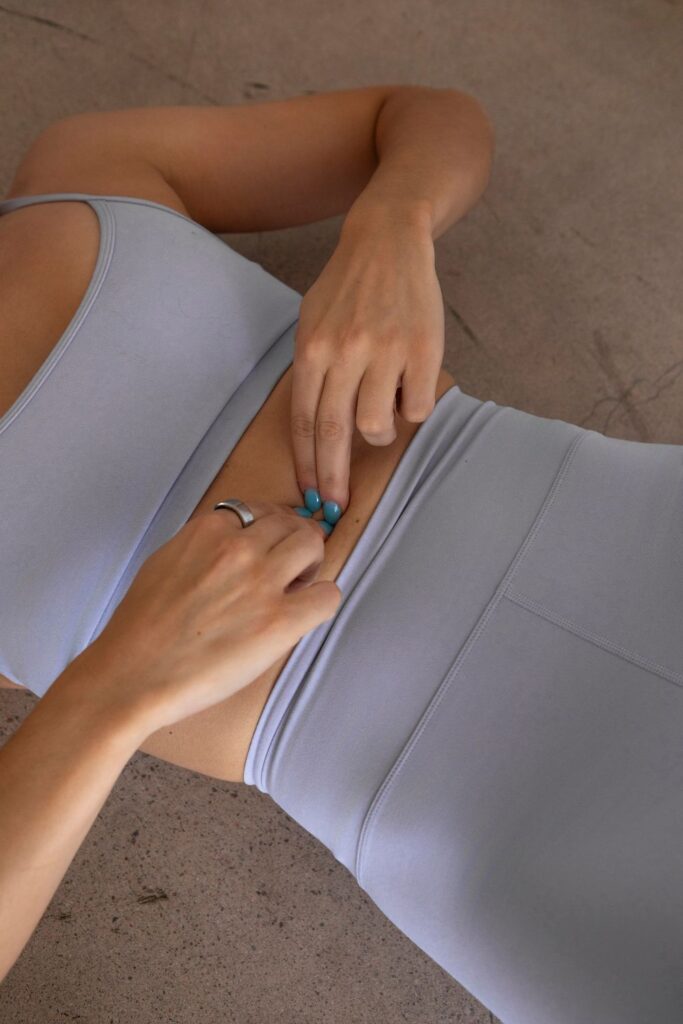
I see this regularly with my clients: a woman comes to me having been told she has a diastasis, anxious and unsure how to move, but when assessed the ‘gap’ is somewhere between 1 and 2 cm. By definition, this does not meet the threshold for diastasis recti.
The commonly used threshold for a true diastasis is a gap of greater than 2–2.5 cm (or roughly two finger-widths). A small amount of separation is entirely normal, even in women who have never been pregnant. If your gap is sitting at 1.5 cm and you’re functioning well, that is not something that requires intensive intervention or fearful avoidance of movement.
Width vs. depth: what actually matters
Here’s where it gets interesting, and where many online voices miss a crucial point.
There is ongoing debate in the research world about whether the width of the gap is actually the most important measure and increasingly, the evidence suggests it isn’t. What arguably matters more is the tension and function of the linea alba: its ability to transmit load, generate tension and support the system under pressure.
This is where depth comes in. You can have a relatively wide gap that has good tension and transfers force well. This would be someone who manages intra-abdominal pressure effectively, breathes well and has a system that’s loading and adapting. And you can have a narrower gap that has poor tension, where the tissue feels like has no resistance when assessed, a linea alba that isn’t doing its job.
What the depth (or lack of tension/resistance) is telling us is that the tissue isn’t yet able to transfer force efficiently. It’s a window into the function of the system, not just the structure. This is why my programming does not fixate solely on closing the gap. I am more interested in restoring the function of the whole core canister: the breath, the pressure management the load distribution.
Chasing a narrower gap through an overuse of targeted core rehab exercises, rather than a full body approach, may not give you function. In fact, the pattern I see most often with clients coming to me for 1:1 training is that they are overthinking their core work entirely.
They arrive having been cued to “zip up from the bottom” for every single exercise because let’s be honest, this cue is everywhere on social media right now and the problem isn’t the cue itself. It’s that it’s being handed out without any of the foundations underneath it. Nobody has taught them how to manage pressure, how to breathe, or how to find a neutral position first. So what it produces instead is a constant clenching and lifting of the pelvic floor, or gripping through the upper abdominals. Sometimes both. The system is braced, held and effortful, which is the opposite of what we’re looking for.
The frustrating part is that this is often happening before the more fundamental questions have been answered. Can she actually expand into her rib cage when she breathes? Not just the belly rising, but a genuine lateral and posterior expansion? And when it comes to positioning, can she quietly hold a rib-pelvis stack without recruiting full body tension to get there? If the answer to either of those is no, then layering more core exercise on top is not the solution. We need to go back further to better manage intra-abdominal pressure.
In short: both width and depth are feedback, not a verdict. They tell us what the system needs — better coordination, pressure control, or full-body strength but neither one alone defines your progress.
Let’s break down what progress really looks like
Tension Across the Linea Alba
The linea alba is a sheet of connective tissue that runs vertically down the center of your abdomen, connecting the left and right sides of your rectus abdominis. During pregnancy, it stretches to allow room for your growing baby. That stretch is normal, but afterward the goal isn’t to “tighten it back up.” Instead, it’s to restore the tissue’s ability to transfer force — in other words, to create tension when your core is working.
You might notice that early on, the midline feels soft or your fingers sink in when you press down. Over time, with consistent rehab and strength work, you should feel more firmness when you activate your core — whether that’s lifting your head in a basic assessment, holding a plank, or pressing weights overhead. This responsiveness is far more important than the width of the gap itself.
- Progress looks like the linea alba becoming load bearing again. Firming up when you exhale, move, or lift.
- You’ll notice less sinking through the midline and more spring like tension that gives your core system stability.
- The ability to generate tension across the gap is what supports your spine, pelvis and breath mechanics, not just how many fingers wide the gap measures.
In other words, think of the linea alba like a bridge. It doesn’t need to be closed completely; it needs to be strong enough to handle the weight placed on it.
→ Example Drills
Try these:
- Rockback Breathing with Reach: This drill puts you in a supported position (hips back toward heels, forearms reaching forward) that naturally encourages posterior rib expansion. By expanding the breath into the back and sides of the ribcage, the deep core and pelvic floor can respond more effectively. That improved 360 breathing improves overall core engagement and pressure management.
- 90/90 Leg Lowers with Block: In a supine 90/90 position with a block squeezed between the knees, you create adductor and pelvic floor engagement while lowering one leg at a time. This adds movement and load to the system while training the abdominal wall to stay taut instead of bulging or sinking. It’s an excellent way to build tension across the linea alba under dynamic demand, bridging the gap between rehab drills and more advanced strength work.
Load Tolerance
It’s one thing to check your core lying down in a relaxed position but that only gives a small piece of the puzzle. True recovery is measured in how well your core handles load, because that’s what real life demands. Whether it’s carrying your baby, squatting down to pick up toys, or pressing a weight overhead, your core has to respond to and transfer force.
In the beginning, you might notice that your core can’t manage even small loads without coning, bulging, or feeling unstable. Over time, with progressive strength work, you should be able to move from simple, supported exercises to heavier or more dynamic movements with more control. This is where confidence really builds. Not because the gap looks smaller, but because your system is able to do more without symptoms.
- Progress looks like moving from bodyweight exercises to loaded ones without doming or discomfort.
- You may notice you can hold positions longer and with more stability.
- Everyday demands feel easier and less fatiguing.
Ultimately, load tolerance tells us whether your core is not only healing but also functional. A core that can manage increasing challenges is a core that’s truly resilient.
→ Example Drills
Front Rack + Suitcase Squat
By holding one weight in a front rack position and another at your side, this squat forces your core to resist tipping, rotating, or collapsing under asymmetrical load. It directly trains your ability to stabilize while lifting, carrying, or moving uneven weight — just like everyday life with kids, bags, or groceries. The diastasis-specific benefit is that your linea alba and deep core learn to distribute tension evenly, not just in perfectly balanced situations.
Pallof to Overhead Press
Starting in an anti-rotation press (Pallof), you extend your arms forward, then press overhead without letting your trunk rotate or ribs flare. This sequence challenges your core to manage rotation, extension, and vertical load all at once. It reinforces both rib-pelvis alignment and the ability to tolerate more complex, functional demands — critical milestones in DR recovery.
Pressure Management Under Brace
Your core isn’t just muscles, it’s a pressure system made up of the diaphragm, deep abdominals, pelvic floor, and the connective tissue that links them together. When these pieces work in sync, pressure is distributed evenly, creating stability and support. When they don’t, you might notice signs like coning through the midline, bulging at the belly, or leaking through the pelvic floor.
Early on in recovery, many people unintentionally hold their breath or brace in ways that push pressure outward or downward. This makes the linea alba and pelvic floor take the brunt of the load. As you retrain, the goal is to learn how to use your breath and posture to regulate pressure so your whole system shares the work. Over time, this feels smoother and more automatic, like your core is supporting you in the background instead of something you have to consciously think about.
- Progress looks like being able to inhale and exhale without your belly bulging forward.
- Lifting, carrying, or moving under load feels supported instead of strained.
- You experience fewer pressure leaks. Less coning, less doming, and fewer pelvic floor symptoms like heaviness or leaking.
In other words, pressure management is what ties everything together. It’s not about bracing harder; it’s about coordinating breath and muscle activation so your body responds efficiently under stress.
→ Example Drills
Bear Plank with Balloon Breathing
In the bear plank, hands and toes press into the floor while knees hover under the hips. Adding balloon breathing teaches you to regulate intra-abdominal pressure instead of pushing it forward into the belly or down into the pelvic floor. The resistance of the balloon forces a longer, controlled exhale, which restores balance between the diaphragm, pelvic floor, and deep abdominals. This resets your pressure system while challenging your core under load.
Dumbbell Pullover in Iso Bridge
Lying in a hip bridge with ribs stacked, you perform a pullover with the dumbbell overhead. This integrates rib positioning, glute activation, and breath mechanics in one movement. The isometric hold at the hips ties the core and pelvis together, while the pullover challenges you to resist rib flare. It’s a powerful way to train pressure management across the whole trunk during both stability (the bridge) and mobility (the arm path).
More Resilience Under Load/Demand
One of the clearest markers of progress with diastasis recti is seeing fewer visible signs of pressure escaping through your core. Coning or doming is your body’s way of telling you that load isn’t being managed well. In the early stages, you might see this often, even during basic movements like sitting up or lifting something light. With time and practice, those signs lessen as your core learns to respond more effectively.
Another key piece is alignment, often called your rib and pelvis stack. When your ribs flare forward or your pelvis tips excessively, your core can’t generate tension efficiently. Restoring a neutral stack gives your system the best chance to manage pressure and share load. Over time, this shows up not only in exercise but also in your day-to-day posture, making movement feel more natural and supported.
- Progress looks like less frequent or less intense coning during movement.
- You’re able to maintain a rib-over-pelvis stack more consistently, even when lifting or moving quickly.
- Your body feels more resilient — tasks that once caused bulging, heaviness, or discomfort now feel manageable and strong.
The ultimate sign of progress isn’t just how your abdomen looks when you test your gap — it’s how much more adaptable and durable your whole system becomes under the real-world demands of motherhood, training, and daily life.
Example Drills
Tall Kneeling Deadfall Slam
From a tall kneeling position, you slam a ball forcefully to the ground. The quick, high-velocity action requires your core to absorb and redirect pressure without losing alignment. This is advanced pressure control training, teaching your system to stay coordinated even when force comes suddenly — much like a cough, sneeze, or quick lift.
Z Sit/Tall Kneeling with Press + Pull
In a Z-sit position (one leg in front, one folded to the side), you press with one arm while pulling with the other. This combines upper body push-pull integration with an unstable base, forcing the core to manage both rotation and eccentric control. It builds resilience under asymmetrical demand and ties upper body strength into pelvic and core stability — exactly what’s needed for real-world, unpredictable movement.
Why a Full-Body Approach Matters
It’s tempting to think of diastasis recti as just a “core problem,” but your core doesn’t work in isolation. Every muscle group that attaches to your pelvis, ribcage, or spine plays a role in how pressure is managed and how stable you feel. That’s why endless sit-ups or isolated ab work won’t solve the issue — you need a full-body approach.
Your glutes, hamstrings, and inner thighs (adductors) all help stabilize the pelvis and support tension through the midline. The lats and back muscles influence rib position and help transfer load between your upper and lower body. Even your breathing patterns and posture directly affect how much pressure your linea alba and pelvic floor have to absorb. When any of these systems are undertrained or out of sync, the core has to compensate.
- Glutes and hamstrings provide pelvic stability, making it easier for the deep core to activate.
- Adductors (inner thighs) connect into the pelvic floor, supporting midline control.
- Lats and upper back improve posture and help manage pressure across the trunk.
- Breath and rib mobility set the foundation for pressure distribution.
When you strengthen these systems together, your core isn’t just healed — it’s integrated. The result is a body that feels coordinated, stable and capable of handling everything from workouts to the daily demands of motherhood.
Healing diastasis isn’t about shrinking a gap. It’s about building a resilient, full-body system that supports you in every way.
Final Takeaway
Progress with diastasis recti is not defined solely by how narrow the gap becomes, instead it’s about how well your body functions as a whole. True healing means being able to generate tension across the midline, manage pressure with breath and movement, and handle increasing loads with confidence.
If you’re ready to start building real strength, coordination, and confidence in your core:
- My Return to Strength program is designed specifically for postpartum women who want a structured path back to lifting — beginning with gentle core rehab and progressing to full-body strength over 6 progressive phases.
- And for those who want to take a deeper dive into rebuilding their core from the ground up, my 3-Phase Core Program walks you step by step through foundations, rebuild, and advanced strength for long-term results.
Your gap doesn’t define your strength. A smart, progressive approach does. Let’s build that resilience together. See you in the app
I’m deeply passionate about helping women feel strong, informed, and confident through every stage of motherhood. You deserve more than just a list of do’s and don’ts or generic modifications. With years of hands-on coaching across all kinds of athletes and clients, I blend real-world experience with specialized pre and postnatal knowledge to create strength programs that go far beyond basic adjustments. This is high-level, accessible training - built for your body, your season, and your goals

EXPLORE MORE POSTS
GET TO KNOW EMILY


