


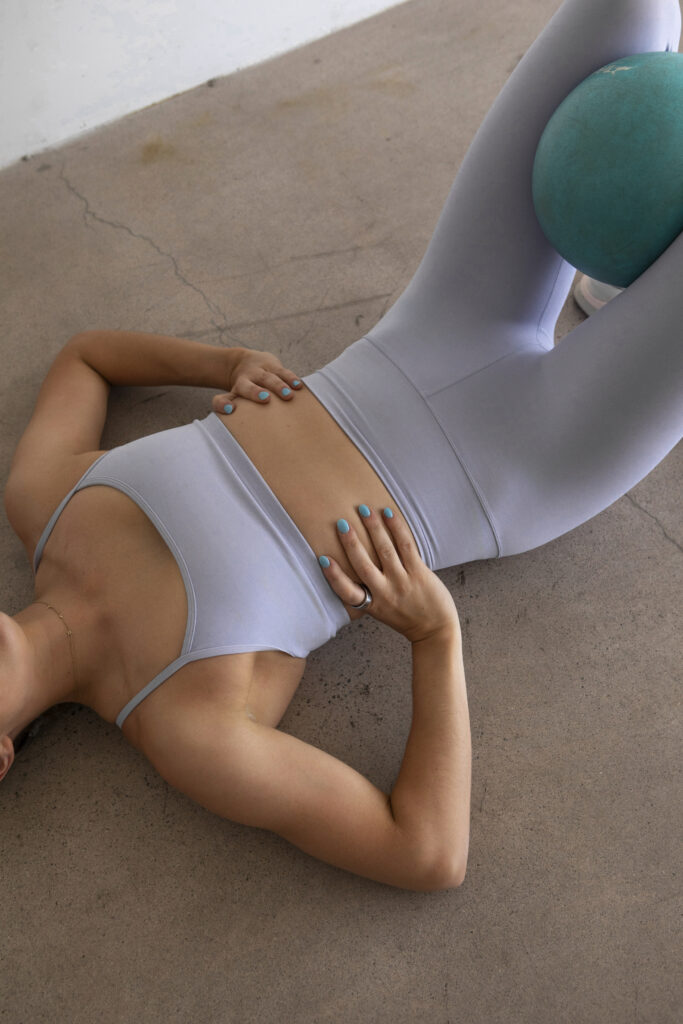
A diastasis recti (DR) is a separation of the two sides of the rectus abdominis, the “six-pack” muscle, at the midline. During pregnancy, as the uterus expands, the linea alba (the connective tissue running down the centre of your abdomen) stretches to accommodate your growing baby. This is not a bad thing. It is not damaging your core. It is your body doing exactly what it’s designed to do.
A diastasis is a necessary adaptation to pregnancy, and yet somehow it’s become one of the most feared diagnoses in the postpartum space. Women are handed lists of exercises to avoid, told their core is broken, or sent home from a six-week check feeling like they need to tiptoe around their own body. This framing is unhelpful and, frankly, inaccurate.
Not Every Gap Is a Diastasis
I see this regularly with my clients: a woman comes to me having been told she has a diastasis, anxious and unsure how to move, but when assessed the gap is somewhere between 1 and 2 cm. By definition, this does not meet the threshold for diastasis recti.
The commonly used threshold for a true diastasis is a gap greater than 2–2.5 cm (roughly two finger-widths) at the level of the umbilicus. A small amount of separation is entirely normal, even in women who have never been pregnant. If your gap sits at 1.5 cm and you’re functioning well, that is not something that requires intensive intervention or fearful avoidance of movement.
Width vs. Depth: What Actually Matters
Here’s where it gets interesting, and where many online voices miss a crucial point.
There is ongoing debate in the research world about whether the width of the gap is actually the most important measure, and increasingly, the evidence suggests it isn’t. What arguably matters more is the tension and function of the linea alba: its ability to transmit load, generate tension, and support the system under pressure.
This is where depth comes in. You can have a relatively wide gap that has good tension and transfers force well. This would be someone who manages intra-abdominal pressure effectively, breathes well, and has a system that’s loading and adapting. And you can have a narrower gap that has poor tension, where the tissue feels like it has no resistance when assessed — a linea alba that isn’t doing its job.
What the depth (or lack of tension and resistance) is telling us is that the tissue isn’t yet able to transfer force efficiently. It’s a window into the function of the system, not just the structure. This is why my programming does not fixate solely on closing the gap. I am more interested in restoring the function of the whole core canister: the breath, the pressure management, the load distribution.
Chasing a narrower gap through an overuse of targeted core rehab exercises, rather than a full body approach, may not give you function. In fact, the pattern I see most often with clients coming to me for 1:1 training is that they are overthinking their core work entirely.
They arrive having been cued to “zip up from the bottom” for every single exercise, because let’s be honest, this cue is everywhere on social media right now. The problem isn’t the cue itself. It’s that it’s being handed out without any of the foundations underneath it. Nobody has taught them how to manage pressure, how to breathe, or how to find a neutral position first. So what it produces instead is constant clenching and lifting of the pelvic floor, or gripping through the upper abdominals, sometimes both. The system is braced, held, and effortful, which is the opposite of what we’re looking for.
The frustrating part is that this is often happening before the more fundamental questions have been answered. Can she actually expand into her rib cage when she breathes? Not just the belly rising, but genuine lateral and posterior expansion? And when it comes to positioning, can she quietly hold a rib-pelvis stack without recruiting full body tension to get there? If the answer to either of those is no, then layering more core exercise on top is not the solution. We need to go back further to better manage intra-abdominal pressure.
This is why the foundation matters so much. Restoring breathing mechanics, alignment, and whole system coordination very often does the work, and the gap frequently responds as a byproduct.
So What Does This Look Like in Your Workouts?
An endless list of “diastasis friendly” or “postpartum safe” exercises isn’t going to fix your core if you can’t expand your ribs in all directions, or stack your ribs over your pelvis. Swapping a crunch for a dead bug doesn’t address anything if the breath and positioning underneath it are still off. You’d just be doing the same braced, effortful pattern in a different shape.
This is why I don’t work from a list of “safe” or “unsafe” exercises for diastasis. There isn’t one. What matters is whether your system, breath, rib position, and pressure management can support what you’re asking it to do. Build that foundation, and the exercise itself becomes far less of a risk factor. Skip it, and even the gentlest “diastasis friendly” move can be loaded on top of a system that isn’t ready to manage it.
This Doesn’t Mean You’re Limited
None of this means avoiding challenge. If anything, it’s the opposite.
What it looks like is individual, and that’s the part that gets lost in a one-size-fits-all “avoid this, do this instead” list. Two women with what looks like the same gap on assessment can need completely different things, depending on their breath mechanics, their pressure management, how they load, and what their body has adapted to since giving birth. There is a lot of nuance here, and it rarely fits into a tidy list.
I’d also argue that a lot of postpartum programs make the opposite mistake to the one this post has been describing. Instead of overloading a system that isn’t ready, they underload one that is. Endless gentle core activation with no real progression doesn’t give the tissue or the nervous system a reason to adapt. Once the foundation, breath, alignment, pressure management, is in place, the core canister needs to be genuinely challenged: loaded, put under fatigue, asked to work in different positions and planes, in order to keep building capacity. Staying in “safe” beginner territory indefinitely isn’t protecting you. It’s just delaying progress.
The Takeaway
There is no such thing as a “diastasis friendly” exercise list, because your diastasis was never the whole picture. What matters is whether your breath, rib position, and pressure management can support what you’re asking your body to do. Build that, and the exercise itself stops being the risk factor. Fixate on the gap alone, and you can do everything right on paper and still not feel strong.
This is exactly the approach Return to Strength is built on: restoring breath, alignment, and pressure management first, then progressively and genuinely challenging your core canister, so you’re building real capacity, not just avoiding a list of exercises indefinitely.
Start your 7-day free trial of Return to Strength today!
I’m deeply passionate about helping women feel strong, informed, and confident through every stage of motherhood. You deserve more than just a list of do’s and don’ts or generic modifications. With years of hands-on coaching across all kinds of athletes and clients, I blend real-world experience with specialized pre and postnatal knowledge to create strength programs that go far beyond basic adjustments. This is high-level, accessible training - built for your body, your season, and your goals

EXPLORE MORE POSTS
GET TO KNOW EMILY


